IP Address News

Providing you with a single site about IP Addresses News and Usage

IP Address News - Providing you with a single site about IP Addresses News and Usage

Inter-RIR IPv4 transfers begin

ARIN announced today the implementation of the Inter-RIR IPv4 transfer policy (2011-1).  This policy, which has been discussed over the past two meetings was controversial for a number of reasons including that it would potentially move a lot of address space from the ARIN region to other regions.

Since the policy requires a compatible policy with each RIR only the APNIC region will currently be able to perform transfers under this policy.

ARIN has released new guidelines for “8.4 Inter-RIR Transfers to Specified Recipients”.

The announcement also included a note about a twitter discussion to be held August 8th to discuss the new policy.

IANA Contract Awarded to ICANN

After a withdrawal in the contracting process in March, the US Government via the National Telecommunication & Information Administration (NTIA) renewed its contract with ICANN for the IANA operations functions earlier this month.  The new contract begins in October of 2012 with an initial 3 year term.  Two 2-year terms are included as options in the contract.  There was some speculation back in March as to the reasoning behind the awkward process, but a reset appears to have renewed the contract as was originally expected.

http://www.ntia.doc.gov/press-release/2012/commerce-department-awards-contract-management-key-internet-functions-icann

Copies of the contract are linked from the NTIA’s website for those who want to dig into the details of the new agreement.

http://www.ntia.doc.gov/other-publication/2012/icann-proposal

ICANN has also posted their proposal to the US Department of Commerce on their website.

http://www.icann.org/en/news/announcements/announcement-2-09jul12-en.htm


IPv6 Launch Day Wrap Up

IPv6 Launch Day was June 6th 2012.  As expected a number of high profile content providers such as Google, Microsoft (Bing), and Yahoo inserted DNS IPv6 records known as quad-A records for their main website into the global DNS.  I just did a quick check on a few of these sites and found their IPv6 record still are live and active.  With the quad-A records in place this allows those with native IPv6 connectivity to reach these sites wholly over IPv6.  This  is a great milestone, but still only a small step along the way to IPv6 adoption.

As I have discussed earlier, in this blog and in my other papers, I believe the main area which needs attention for IPv6 to become the dominate and majority protocol carrying Internet traffic is adoption by broadband providers servicing residential and commercial customers.  Until we see large deployments with tens of thousands if not millions of IPv6 customers by companies such as Comcast, Verizon, and AT&T the road to a viable IPv6 infrastructure remains somewhat uncertain.

Below are a few other articles with good wrap-up information from the IPv6 Launch Day event.

ARIN Returns IPv4 Addresses to IANA

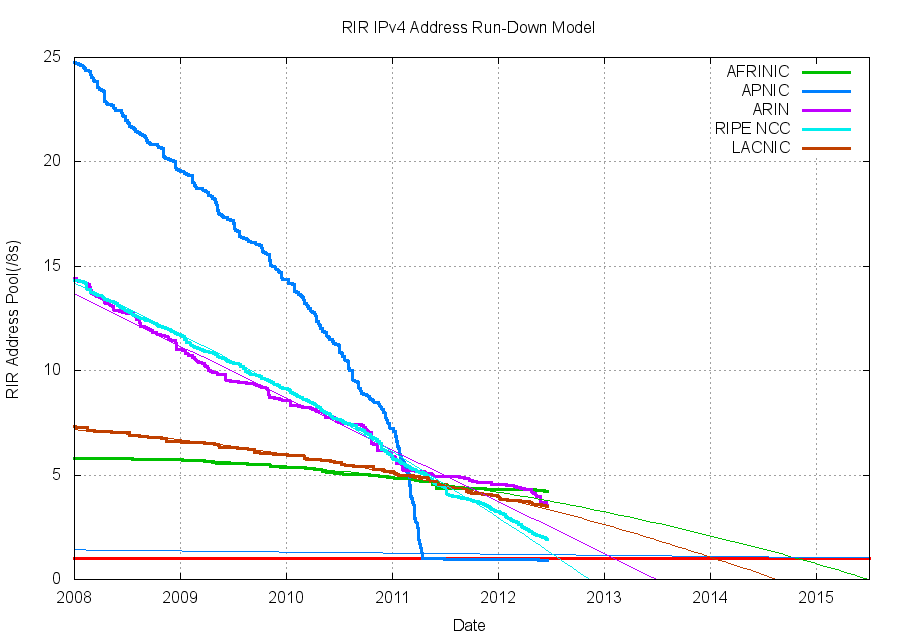
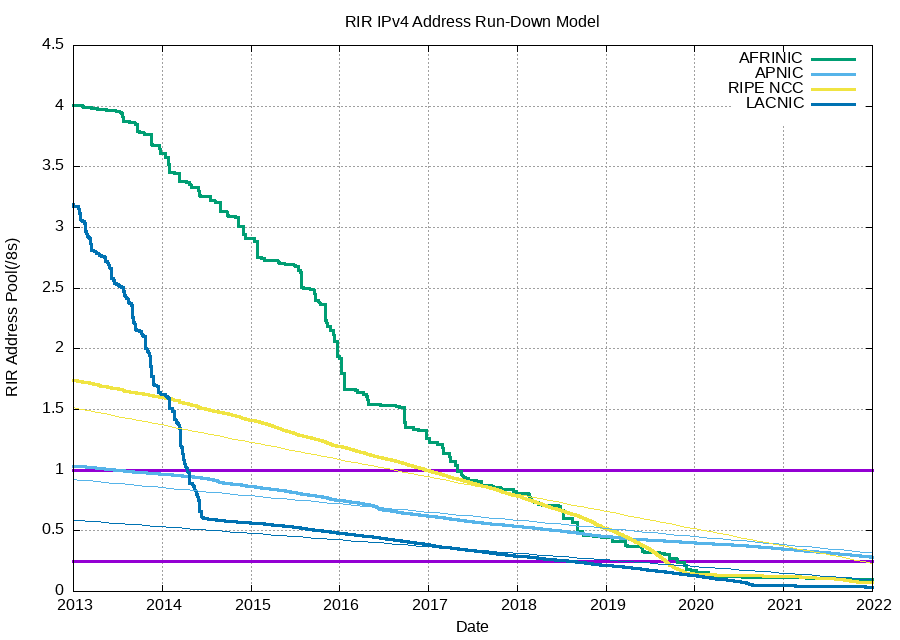
After the adoption of the Global Policy for Post Exhaustion of IPv4 resources by the ICANN board, the ARIN board has decided to return to IANA some of the resources that it had received back from legacy address address holders.  All of this space is the equivalent of a /8.  The largest part of this block came from Interop who returned almost a /8 to ARIN in 2010.  The long-term effect of this will bring ARIN’s IPv4 exhaustion date closer to RIPE’s exhaustion date which is expected this year.

From: Geoff Huston’s IPv4 Address Report

Presumably IANA will now proceed to reallocate this address space to all 5 RIRs according to the global policy.  However, given that some RIRs currently have a sufficient free pool one would expect them to decline the reallocation of space, thus a majority of the space seems likely to go to either APNIC or RIPE.  APNIC’s current IPv4 policy, however, would only allow blocks of size /22 or smaller to be allocated.

From a practical perspective, it seems like it would have been more reasonable for ARIN to just return the largest blocks and reallocate the small blocks to new or existing IPv4 address holders.  However, the final /8 allocations process by chance ended up giving ARIN a much larger supply than was needed compared with the other RIRs.  Thus, it seems likely the ARIN board felt compelled to “right this wrong” as well as to continue its previously existing operational procedure to return to IANA IPv4 space received from organizations prior to ARIN’s formation.


ARIN XXIX meeting update

ARIN’s XXIX regional meeting in Vancouver, Canada concluded last week.  A couple of notable discussions occurred.

An updated IPv4 transfer policy 2012-1 was discussed alongside the 2011-1 inter-RIR transfer policy which is pending implementation and board adoption.  ARIN staff noted that the inter-RIR transfer policy will be ready for implementation in about 90 days.  I expect that the ARIN board will implement and move forward with implementing inter-RIR transfers using the revised 2012-1 text which is currently in last call on the public policy mailing list.

A policy 2012-3 to allow ASN numbers to be transferred in a method similar to the existing IPv4 transfers was recommended for last call.  While the circumstances for transfer are different compared with IPv4 transfers, ARIN’s general counsel is recommending that adopting the policy reduces legal liability for ARIN.  During the meeting it was also noted that there is an existing bankruptcy case pending which contains an ASN which has been requested to be transferred.  It seems likely that the board will adopt this policy in due time.

Finally, the community considered a policy 2012-4 to reverse the current 3 month supply restriction on IPv4 allocations.  This policy would have modified the policy to allow a 12-month supply while ARIN has at least a /8 equivalent in its free pool.  This policy would likely have caused the run-out in the ARIN region to proceed faster.  The policy was recently abandoned by the Advisory Council which indicates the current 3 month supply policy is likely to continue until ARIN’s IPv4 free pool is exhausted.